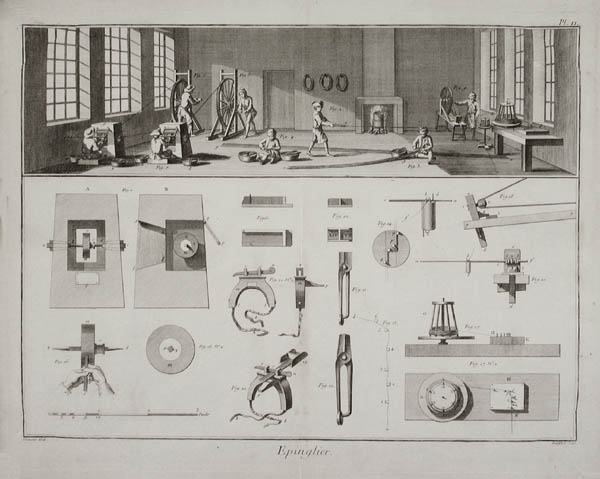
— Gilbert Simondon, On the Mode of Existence of Technical Objects
My research examines the history and politics of technological modernity. I am particularly interested in the ways the material infrastructures of the modern world embody and uphold relations of power and domination, despite promising to liberate humanity from scarcity and toil. My work is therefore concerned with what thinkers of the industrial age from Karl Marx to Gilbert Simondon have characterized as “technological alienation,” which I understand broadly as the process by which technical realities emerging from collective human practice acquire an autonomous force over and against the subjects implicated in their making. I examine this problem through a historical and philosophical lens, paying special attention to the cultural and intellectual formations within which technological change is negotiated and rendered intelligible in the modern West – particularly philosophy and the human sciences.
My doctoral research centered on the longue durée of industrial modernity and the historical emergence of what the early Frankfurt School theorists called “instrumental reason,” tracing its roots to the nineteenth century. My dissertation, Karl Marx, Philosopher of Technics: Critique, Alienation, and the Materiality of Social Power, grounded this inquiry in mid-19th-century debates on technology and political economy that informed the earliest systematic appraisals of industrialization, including Marx’s own intervention. Drawing on understudied materials from the Marx-Engels Gesamtausgabe (MEGA²), I reconstructed how Marx came to understand the relationship between capitalism and the modern technical system, against the backdrop of a techno-determinist common sense growing out of the Industrial Revolution. Following the historical-critical edition of Marx’s technological notebooks and the associated MEGA² scholarship, I focused on the influence of Charles Babbage and Andrew Ure on the writing of Part IV of Capital, Volume I, dedicated to the capitalist transformation of the labor process. I argued that, contrary to prevailing economicist and productivist readings, Marx theorized industrial development and its constitutive mechanism – the “subsumption” of the labor process by capital – as an alienated organization of human-technical relations, whereby capitalist imperatives become embedded in the technical conditions of human life. On this reading, rather than celebrating industrialization as the prerequisite for a post-capitalist future, as official Marxism often insisted, Marx’s account of large-scale industry sought to unsettle the techno-determinist identification of technological progress with human emancipation underwriting an ascendant faith in industrial civilization.
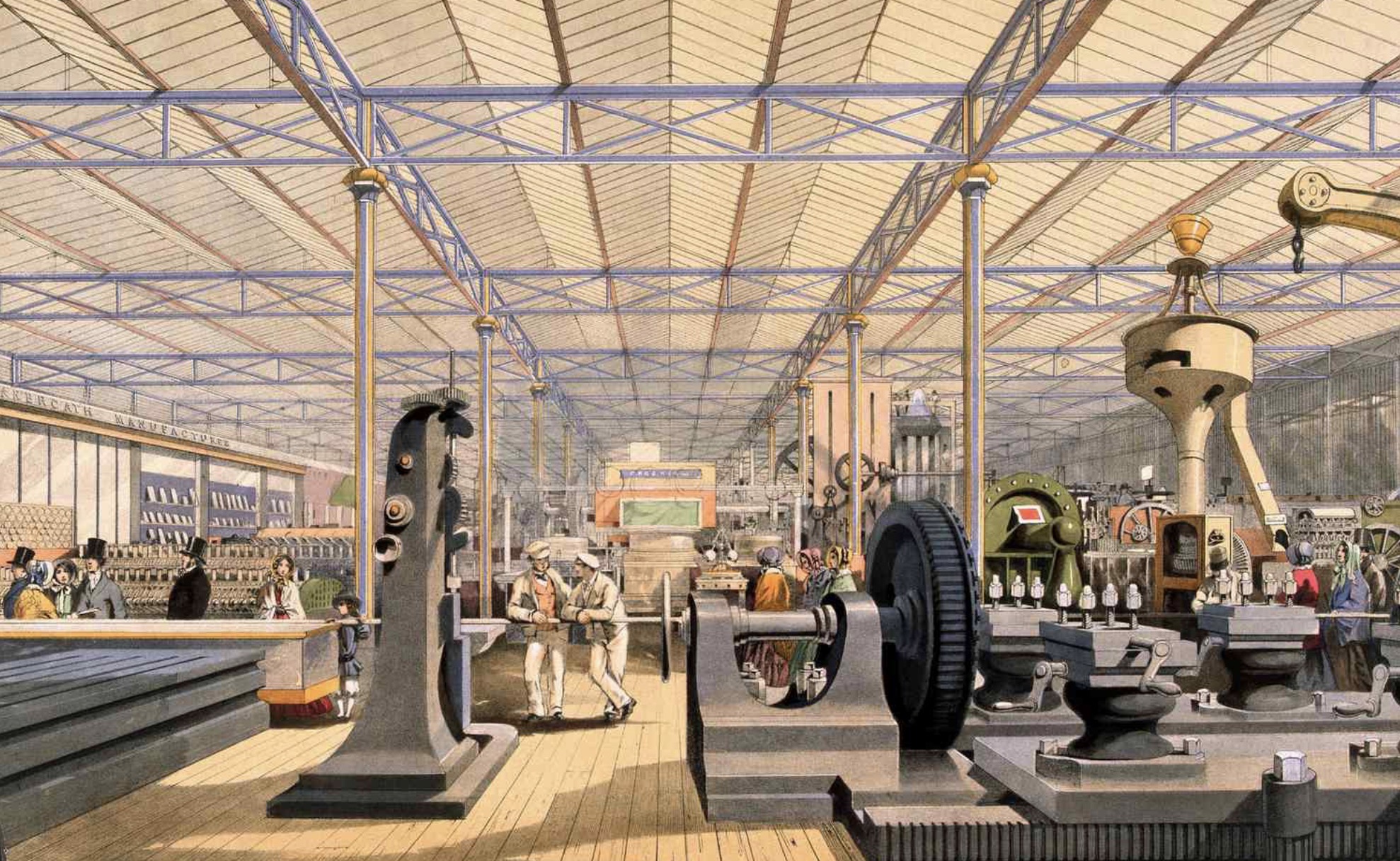
Machine Hall, The Great Exhibition of 1851

Karl Marx (1845), Notes and excerpts from the French translation of Charles Babbage’s On the Economy of Machinery and Manufactures (1832)
As I revise this work into a monograph, my ongoing research traces how the capitalist dynamic of subsumption has steered the course of the information age and is reasserting itself in the contemporary AI project – particularly in its claim to instantiate intelligence itself through the statistical modeling of human language use. Against the market-driven presentism of the contemporary AI debate, my current research seeks to place machine intelligence within its longue durée, as the latest development in the history of industrial automation undergirding late capitalism’s digital turn. My wager is that the computational infrastructure that has come to mediate so much of contemporary life is best understood not merely as a “means of production,” in the classical Marxist sense, but as a subsumptive technique that generalizes the industrial form of the labor process – that is, the organization of human activity and social cooperation according to a logic of labor-time abstraction.
Since the postwar period, the advent of the modern electronic computer has been celebrated for reintroducing human feedback into the unthinking, mechanical apparatuses of industrial modernity. By making external input and self-regulation integral to machine operations, the computer promised to reverse the decline of reflexivity that 20th-century critics, from phenomenology and existentialism to early critical theory, ascribed to mechanization and the reign of instrumental reason. Yet this optimistic self-image of the digital age has consistently faced scrutiny within media and technology studies – most pointedly in light of Gilles Deleuze’s late concept of “control societies,” which directly linked the rise of information machines to a new diagram of power. Building on my previous inquiry into the relationship between social and technical forms, my current project takes up, more specifically, the relationship between computation and the industrial labor process, turning to the 20th-century history of computing, postwar appraisals of machine intelligence in the human sciences, and their ideological afterlives. Paying particular attention to the development of early real-time, command-and-control computer systems, such as the Whirlwind I and SAGE, and their connections to mid-century debates within the cybernetics movement and the nascent field of AI, I aim to ask how the social ontology of computational technologies is bound up with capitalist forms of cooperation, and whether the socialized intelligence they harness makes possible alternative, non-alienated social relations.
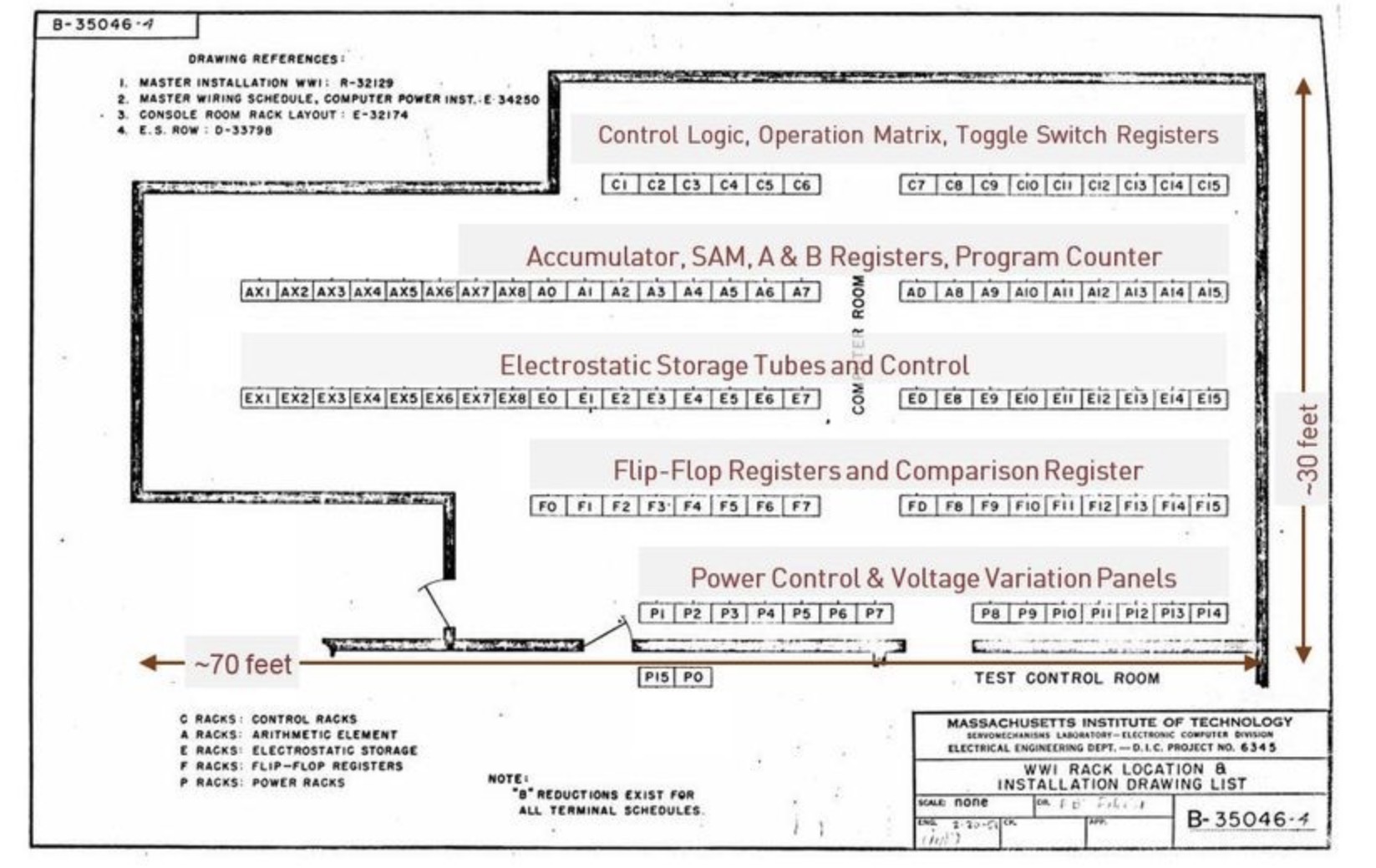
Whirlwind Computer Room Floor Plan, Barta Building, MIT (1951)
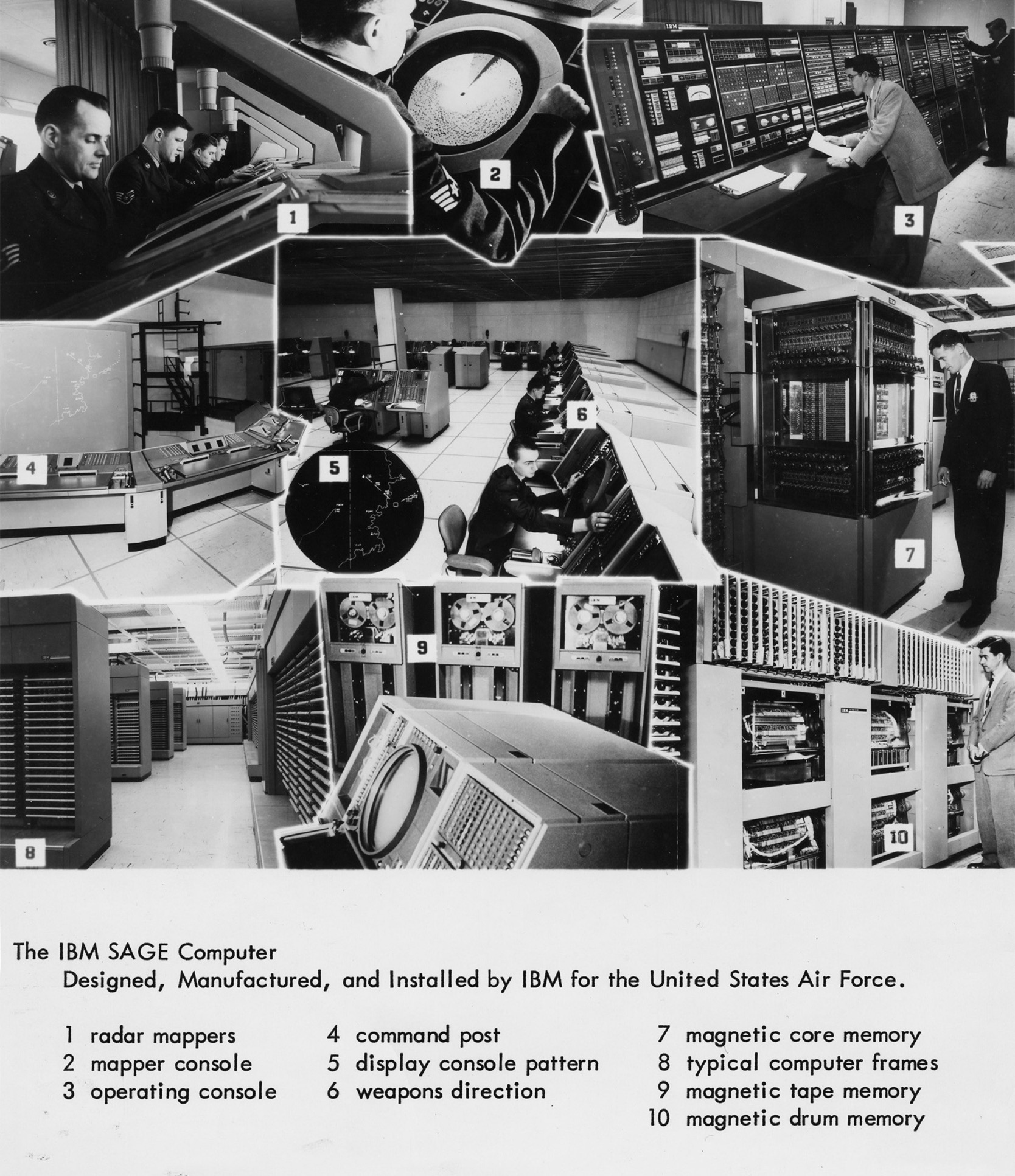
Components of the IBM Semi-Automatic Ground Environment (SAGE) computer system (1951-1963)
Work in Progress: Computation and Social Form
What is a computational system and what form of human grouping begets its existence? Or put another way, what is the form in which modern humans confront materiality such that it requires an automated system of “control and communication” (Wiener)?
A computer is, according to most modern definitions, a system that performs sequences of mathematical or logical operations on inputs according to rules specified in advance. So defined, many technical systems preceding the digital electronic computer would qualify as “computational,” from the Jacquard loom to the group of human calculators employed in the production of logarithmic tables until the late nineteenth century. Yet it is only under conditions of advanced industrial development that computational systems have come to organize social life as a whole, embedding information-processing operations in nearly every facet of the modern lifeworld. From scientific research, manufacturing, and the circulation of goods and people to the tracking and management of consumer desires, behaviors, and political sentiments, there seems to be no aspect of life in contemporary society that is not either directly or indirectly mediated by computational processes. It is, therefore, unsurprising that the digital has come to function as a technological synecdoche for late capitalism itself – as a new form of “enclosure” that, like its analog predecessors, abstracts and effaces the heterogeneities of the material world so as to render it exploitable. In this vein, theorists of the digital (Galloway, Chun, Franklin) have interpreted the contemporary ubiquity of code and data as the organizing logic of globally networked capitalism, extending and revising Deleuze’s account of “control societies” as a regime of algorithmic modulation replacing the discrete enclosures of disciplinary society.
Yet is control and domination by logico-mathematical principles all there is to computational processes and the machinic modes of intelligence they enact? While the digital computer has emerged from and ultimately serves, in its present form, capitalist forms of domination, the notion that computational technologies are inherently functional to that purpose deserves further investigation. As some contemporary media-theoretical accounts of computation propose (Hansen, Parisi, Hui, Fazi), computation understood as a general material-cosmological operation is not reducible to the computer-regulated networks of communication and control it has become narrowly associated with in our times. The way capitalism deploys computational processes does not, in other words, exhaust the world-making potentials that digital technologies exhibit, particularly their capacity to widen the scope of human sensibility and self-understanding beyond received anthropocentric norms.
In my current research, I aim to work through this tension by studying what I am calling the “social ontology of computation.” My working assumption is that adjudicating between the conflicting valences of computational technologies is possible only by grasping the historically specific forms of social cooperation they mediate. As I discuss next, this entails clarifying the relationship between abstract forms of social mediation and alienation – a problem for which we find indispensable resources in the work of thinkers like Marx and Simondon, who recognized it as the central pathology of industrial society. The fundamental question I want to pose through this investigation is whether abstract social mediation is itself the source of alienation, or whether alienation arises from the social form through which abstraction is organized.
— Gilles Deleuze, Postscript on the Societies of Control
Abstraction, Digitality, Alienation
My working hypothesis concerning computation is as follows: contemporary computational systems are formally determined by the industrial labor process, understood as a historically distinct arrangement of the interface between humans and machines arising with capitalist modernity. More precisely, the industrial labor process provides the social form within which the technical features of computation become intelligible and materially realizable – without, for this reason, mechanically causing the modern electronic computer to exist or determining its empirical content.
By “industrial” I do not mean the specific technologies and manufacturing processes of a bygone Victorian or Fordist era, now seemingly superseded by a de-industrializing world, but a distinct organization of human labor and social cooperation modeled on commodity relations and the reproduction of capital. What distinguishes this industrial form is not, as the common understanding would have it, the productive employment of humans, machines, and nature for maximum physical output, but rather the allocation of abstract labor-time in the most value-efficient manner. This organizational principle, however, should not be confused with the “profit motive” to which orthodox Marxism accorded explanatory primacy. Nor does it imply that all social activity directly assumes this form, or that the concept of “industry” narrowly refers to the factory and the production of physical goods. State bureaucracies, the military-industrial complex, the culture industry, and the array of modern institutions that Michel Foucault characterized as “disciplinary” equally belong within this historical arrangement whereby human bodies are organized and rendered productive against a common standard of efficiency.
As a growing body of scholarship in the history of computing has argued (Daston, Schaffer, Pasquinelli), mechanical calculation developed in close relation to industrially organized mental labor, suggesting a shared operational logic. Indeed, if the industrial coupling of humans and machines necessitates a systematic regimentation of work and value, then computation is the mechanism by which the modern technical system makes this requirement operational at scale. What is more, as informational processes become more granular, recursive, and operative across the whole system, they also become increasingly inscribed in the self-regulation of its parts. This technical tendency toward machine autonomy is not, contrary to conventional Marxist and Schumpeterian accounts, sufficiently explained by extrinsic economic imperatives – such as profitability, labor-saving, or competitive pressure, which are compatible with other technical paths. Instead, as labor-process theorists have shown (Noble, Braverman, Panzieri), it results from the mechanism through which the industrial labor process formally determines the material content it subsumes: the operationalization of the division of labor.
In its drive to allocate abstract labor-time with maximal efficiency, large-scale industry models every process as a sequence of rule-governed operations that can be decomposed and formalized independently of physical embodiment. To subsume an activity under the industrial form is, in this regard, to sequence its mechanical and human contributions appropriately yet without making ontological distinctions between them, as functional equivalents capable of rule-governed conduct. In fact, labor and rule-following become coextensive in this context, and machinic intelligence thus comes to rest on an algorithmic automatism formally encapsulated by the Turing machine. I contend that, despite the contemporary turn to probabilistic reasoning and the unprecedented possibilities that machine inference has opened up, the “synthesis of word and number” (Weatherby) achieved by large language models does not fundamentally depart from this tendency and its underlying logic of labor-time abstraction. Machine autonomy, as the broader history of automation attests, does not constitute a rupture but an immanent development of the industrial labor process – even as machine learning algorithms now automate programmability itself, the “rule-writing” process that previous waves of automation entrusted to the human engineer, recomposing it as data annotation and evaluation.
The organizing questions of my ongoing research are as follows. If contemporary computational systems are the “transindividual” medium of social cooperation based on commodity relations, do all similar modes of abstract mediation entail reification, as a certain Lukácsian line of thinking (Adorno, Sohn-Rethel, Postone) would have it? In other words, does the social ontology of computation necessitate oppressive forms of valuation like the capital relation? Or is what critical theorists call reification no more than the functional differentiation of autonomous subsystems, inherent in all social formations, as systems theory claims? Between Lukács and Luhmann, a third Simondonian path might suggest that alienation is not a function of mediation itself but of a truncated collective individuation. After all, an alternative system of social cooperation based on universal need satisfaction would still seem to require its own means of commensuration for comparing and reconciling non-identical contents, computation thereby grounding human flourishing rather than a self-moving abstraction. Whether these questions can be answered conclusively is what I am presently contending with, but I hypothesize that the unrealized tendencies that computational systems exhibit, even when enfolded in an oppressive social world, suggest a non-alienated form of abstraction implicit in general social cooperation.